
Blog
Boris Johnson’s burka jibe: Why do some Muslim women wear the veil?


EPA
Former foreign secretary Boris Johnson has been criticised for saying Muslim women wearing burkas “look like letter boxes” and for comparing them to “bank robbers” – prompting calls for him to apologise andbe expelled from the Conservative Party
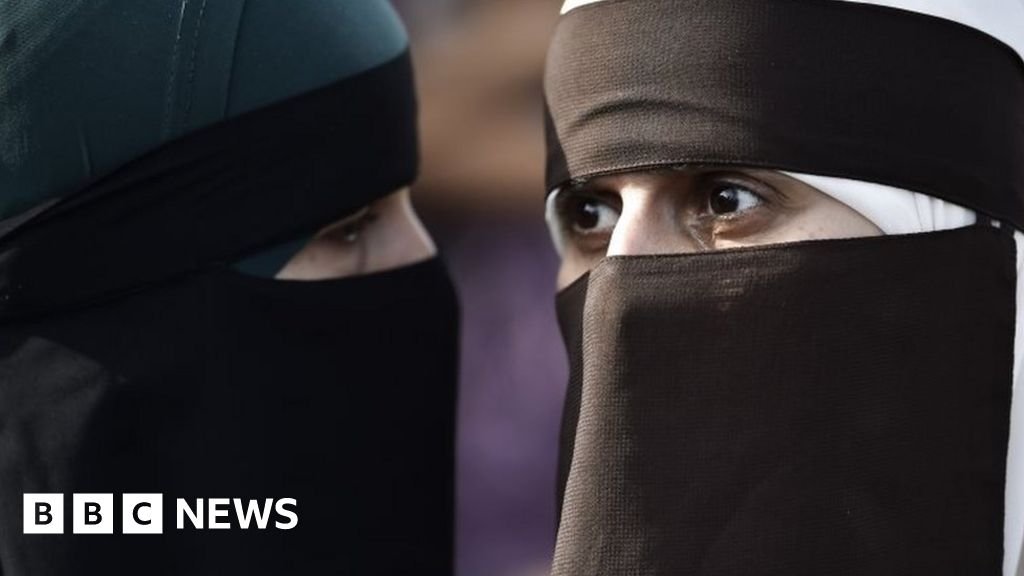
But Mr Johnson’s comments, which some believe will aggravate Islamophobic tensions in the UK, have also highlighted some confusion about what a burka is – as the veil revealing just the eyes is, in fact, known as a niqab
So what actually are the differences between the various types of Islamic dress for women and what governs their choices?
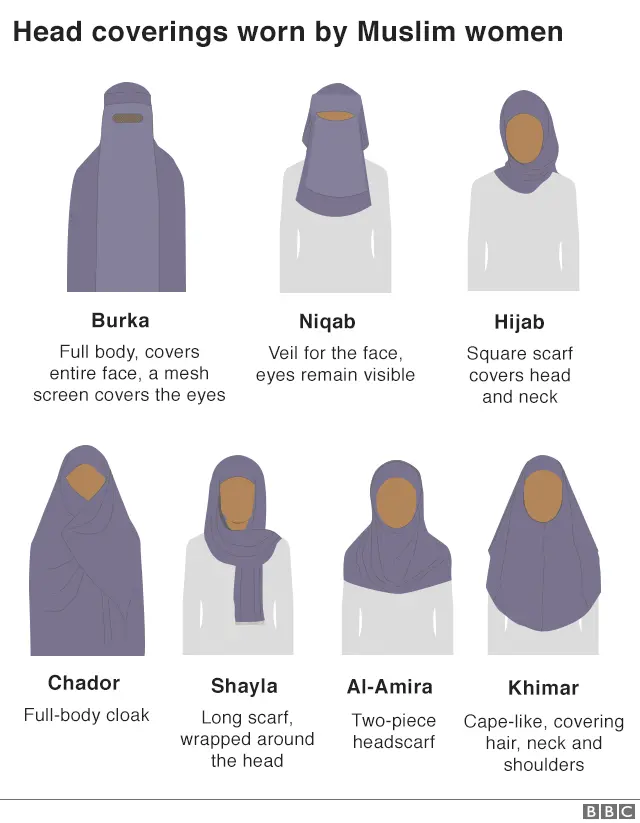

The Koran, Islam’s holy book, tells Muslims – men and women – to dress modestly. Male modesty has been interpreted to be covering the area from the navel to the knee
For women it is generally seen as covering everything except their face, hands and feet when in the presence of men they are not related or married to
However, there has been much debate within Islam as to whether this goes far enough. This has led to a distinction between the hijab (literally “covering up” in Arabic) and the niqab (meaning “full veil”)
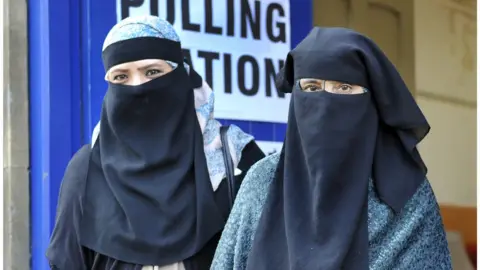
The hijabis typically a scarf that covers the hair and neck, whereas the niqabis a veil for the face that leaves the area around the eyes clear. It is worn with an accompanying headscarf or anabaya, a full-length robe, and sometimes with a separate transparent eye veil
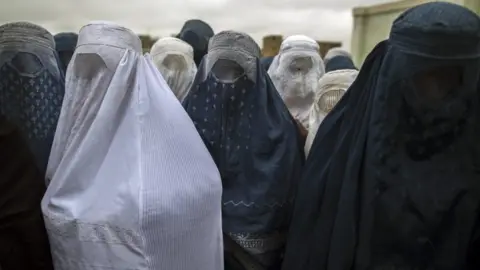
The burkais the most concealing – covering the entire face and body, leaving just a mesh screen to see through
UK mother-of-seven Tahira Noor, who has been wearing a burka for 20 years, says it’s “100% my choice” and Mr Johnson’s comments show a “lack of knowledge”
The “majority of the women who wear the burka” she says, are born and brought up in Britain. They are “educated in this country, they’ve been to colleges, universities, and have understood why they want to do what they’re doing,” she told BBC Radio 5 Live
“They’re under no oppression, they’re not doing it because their husbands want them to or their fathers want them to.”
Ms Noor has four daughters none of whom wear a burka
“I haven’t forced my daughters into it because I don’t have to,” she said
“It’s not a must. It’s not an obligation. However… [it] gets you closer to God. It’s a spiritual thing more than anything else.”
She is “not under an obligation” to cover her face but does so because it is “emulating” the Prophet Muhammad
So, how does she respond if asked to remove her covering for security reasons?
“I’m happy to take my veil off,” she said, citing the example of being asked to at a bank
“When I travel, and I do travel, sometimes I don’t even wear [it] because I think it’s a lot easier not to [for] security reasons
“To make comments that they (women who wear burkas) look like bank robbers, I don’t think it’s fair.”
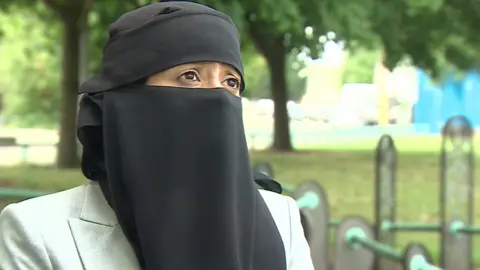
Sahar Al-Faifi, from Cardiff, wears the niqab but told BBC News she sometimes gets verbal abuse from others for her choice of veil
“A week ago someone abused me and said ‘you’re an ugly terrorist’ when I tried to park my car near where I live,” she said
“Two years ago, when I was passing by one department to another at Heath Hospital, someone passed by and said ‘don’t cut off my head you’re ISIS’. It’s quite painful [to hear].”
In 2014, BBC News’ Shaimaa Khalil wrote about why she stopped wearing her headscarf, only to put it back on again when she became the Pakistan correspondent
Dr Qanta Ahmed, a British-American Muslim doctor who lives in New York, does not wear a face veil and supports a ban on them
She said the number of women wearing them in the West is increasing in part because girls begin to wear them before they reach puberty and many were not given a choice
Reuters
Muslim scholars have long debated whether it is obligatory to wear the burka or niqab, or whether it is just recommended
There have also been more liberal interpretations which say any headscarf is unnecessary, as long as women maintain the sartorial modesty stipulated in the Koran
That holy text addresses “the faithful women” who are told to shield their private parts and not to display their adornment “except what is apparent of it”
Scholarly disputes revolve around what this last phrase means. Does it refer to the outer surface of a woman’s garments, necessitating that she cover every part of her body – ie don the full niqab?
Or does it give an exemption referring to the face and the hands, as well as conventional female ornaments such as kohl, rings, bracelets and make-up?
The latter interpretation has been adopted by some of the most prominent scholars from Islamic history who favour the hijab – headscarf – option
There are additional Koranic instructions – seen as ambiguous and therefore much debated – for women to draw the “khimar” (scarf) to cover the “jayb” (bosom/upper chest), and for “the wives and daughters of the Prophet and the women of the believers to draw their “jalabib” (cloaks) close round them”
Getty Images
When contacted by BBC Reality Check, both the Women’s Muslim Council and Faith Matters (an organisation which promotes integration) said accurate numbers weren’t available for the UK
But there does seem to be consensus that the figure is likely to be low
Dr Omar Khan, director at the Runnymede Trust, a think tank that deals with race equality, said that it is likely to be “less than 1% [of the Muslim female population] – how much less is difficult to know”
Sunder Katwala, director of think tank British Future, acknowledged a lack of a “robust methodology”, but said there was a “ballpark estimate in region of 3,000-5,000” with it “very unlikely to be as high as 1-2%” of the female Muslim population
These are both estimates by experts working in relevant fields, but until specific research is carried out, it will be difficult to know how prevalent the full-face veil is
What we do know is that in the 2011 census, Muslims represented 4.8% of the population of England and Wales
Using the most recent population estimates, this would mean there are roughly 1.43 million Muslim women living in the two nations
If the number of Muslim women wearing the niqab were to be as high as 1% – this would equate to just over 14,000 women – but, again, the 1% figure is just an estimate
In other European countries, the figure also appears to be low
In 2009, a French Interior Ministry report estimated that just 0.1% of French Muslim women wore full-face veils which, at the time, equated to 1,900 women
In Austria, a ban of full face veils in public spaces was said to affect just 0.03% of the Muslim population a senior lecturer in public health at Swansea University
In Belgium between 150 and 200 women wore the niqab before a ban came into force, says Michael Privot, director of the European Network Against Racism
Between 150 and 200 women in Demark – which banned face veils in public this month – wore a niqab or burqa on a daily basis
That’s 0.1% of Muslim women in the country, according to the Guardian
EPA
While Boris Johnson’s comments about Islamic face veils have provoked consternation among some, his defenders have said they were made as part of an argument against banning such garments. Other countries though, have taken this step
Francewas the first European country to ban full-face veils – ie burkas and niqabs – in public places in April 2011, seven years after it introduced a law prohibiting conspicuous religious symbols in state schools
It was followed a few months later by Belgium, which banned the wearing of partial or total face veils in public on the grounds of security
Full or partial bans on full-face veils have since been in place in Austria, Bulgaria, the southern German state of Bavariaand, since 1 August, Denmark
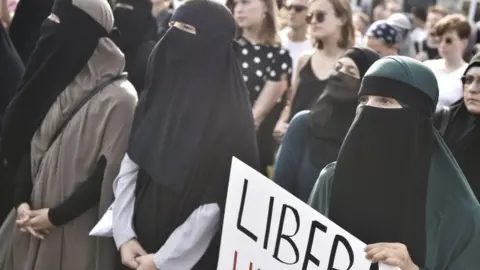
There have been protests against Denmark’s new law, which does not mention burkas and niqabs by name, but says “anyone who wears a garment that hides the face in public will be punished with a fine”
Repeat offenders could be fined 10,000 ($1,500; £1,200) kroner
- The Islamic veil across Europe
- Iran jails woman for removing headscarf
- Iranian women threw off the hijab – then what?
There are posters in cities and towns comparing unveiled women to unwrapped candy and lollipops attracting unwanted attention from flies
Recently, some Iranian women have protested against this law by taking off their headscarf in public. One woman was jailed for two years in March for doing this