

Blog
How Syria rebel leader Abu Mohammed al-Jolani reinvented himself


AFP
Syrian rebel leader Abu Mohammed al-Jolani has dropped that nom de guerre associated with his jihadist past, and been using his real name, Ahmed al-Sharaa, in official communiques issued since Thursday, ahead of the fall of President Bashar al-Assad
This move is part of Jolani’s effort to bolster his legitimacy in a new context, as his Islamist militant group, Hayat Tahrir al-Sham (HTS), leading other rebel factions, announces the capture of the Syrian capital, Damascus, solidifying its control over much of the country
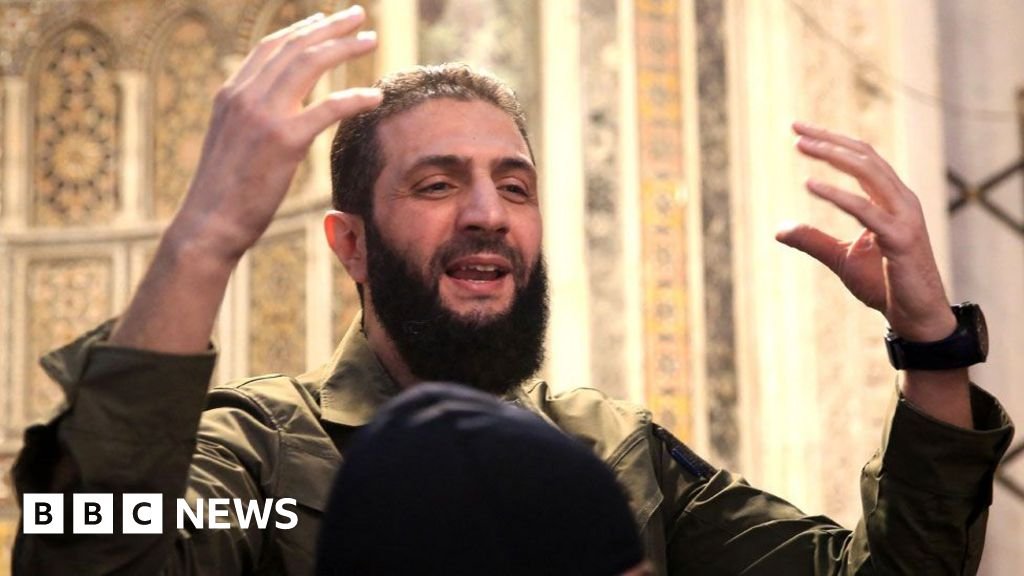
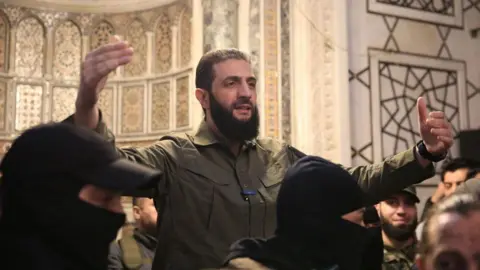
Jolani’s transformation is not recent, but has been carefully cultivated over the years, evident not only in his public statements and interviews with international outlets but also in his evolving appearance
Once clad in traditional jihadist militant attire, he has adopted a more Western-style wardrobe in the past years. Now, as he leads the offensive, he has donned military fatigues, symbolising his role as the commander of the operations room
But who is Jolani – or Ahmed al-Sharaa – and why and how has he changed?
A 2021 PBS interview with Jolani revealed that he was born in 1982 in Saudi Arabia, where his father worked as an oil engineer until 1989
In that year, the Jolani family returned to Syria, where he grew up and lived in the Mezzeh neighbourhood of Damascus
Jolani’s journey as a jihadist began in Iraq, linked to al-Qaeda through the Islamic State (IS) group’s precursor – al-Qaeda in Iraq and, later, the Islamic State of Iraq (ISI)
After the 2003 US-led invasion, he joined other foreign fighters in Iraq and, in 2005, was imprisoned at Camp Bucca, where he enhanced his jihadist affiliations and later on was introduced to Abu Bakr al-Baghdadi, the quiet scholar who would later go on to lead IS
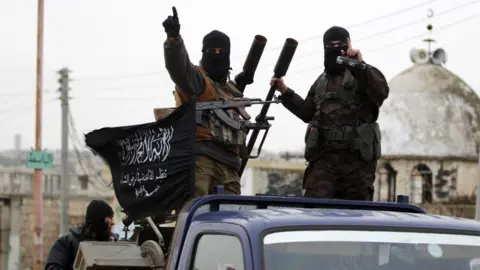
In 2011, Baghdadi sent Jolani to Syria with funding to establish al-Nusra Front, a covert faction tied to ISI. By 2012, Nusra had become a prominent Syrian fighting force, hiding its IS and al-Qaeda ties
Reuters
Tensions arose in 2013 when Baghdadi’s group in Iraq unilaterally declared the merger of the two groups (ISI and Nusra), declaring the creation of the Islamic State of Iraq and the Levant (ISIL or ISIS), and publicly revealing for the first time the links between them
Jolani resisted, as he wanted to distance his group from ISI’s violent tactics, leading to a split
To get out of that sticky situation, Jolani pledged allegiance to al-Qaeda, making Nusra Front its Syrian branch
From the start, he prioritised winning Syrian support, distancing himself from IS’s brutality and emphasising a more pragmatic approach to jihad
In April 2013, al-Nusra Front became al-Qaeda’s Syrian affiliate, putting it at odds with IS
While Jolani’s move was partly an attempt to maintain local support and avoid alienating Syrians and rebel factions, the al-Qaeda affiliation ultimately did little to benefit this effort
It became a pressing challenge in 2015 when Nusra and other factions captured Idlib province, forcing them to co-operate in its administration
Reuters
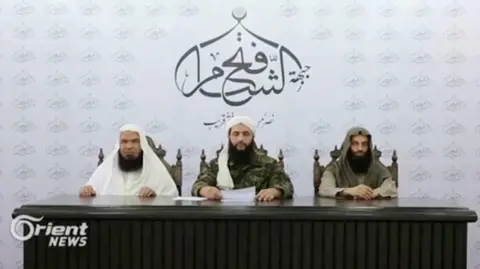
In 2016, Jolani severed ties with al-Qaeda, rebranding the group as Jabhat Fatah al-Sham and later as Hayat Tahrir al-Sham (HTS) in 2017
While initially appearing superficial, the split revealed deeper divisions. Al-Qaeda accused Jolani of betrayal, leading to defections and the formation of Hurras al-Din, a new al-Qaeda affiliate in Syria, which HTS later crushed in 2020. Members of Hurras al-Din, however, have remained cautiously present in the region
HTS also targeted IS operatives and foreign fighters in Idlib, dismantling their networks and forcing some to undergo “deradicalisation” programmes
These moves, justified as efforts to unify militant forces and reduce infighting, signalled Jolani’s strategy to position HTS as a dominant and politically
Despite the public split from al-Qaeda and name changes, HTS continued to be designated by the UN, US, UK and other countries as a terrorist organisation, and the US maintained a $10m reward for information about Jolani’s whereabouts. Western powers considered the break-up to be a façade
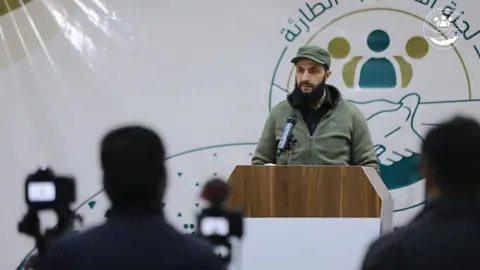
Salvation Government
Under Jolani, HTS became the dominant force in Idlib, north-west Syria’s largest rebel stronghold and home to about four million people, many of whom were displaced from other Syrian provinces
To address concerns about a militant group governing the area, HTS established a civilian front, the so-called “Syrian Salvation Government” (SG) in 2017 as its political and administrative arm
The SG functioned like a state, with a prime minister, ministries and local departments overseeing sectors such as education, health and reconstruction, while maintaining a religious council guided by Sharia, or Islamic law
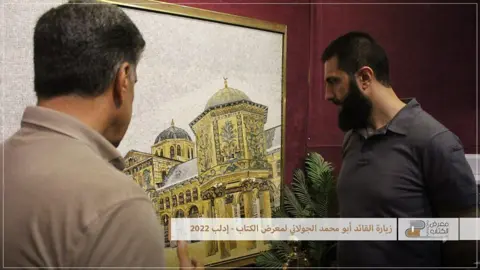
Salvation Government
To reshape his image, Jolani actively engaged with the public, visiting displacement camps, attending events, and overseeing aid efforts, particularly during crises like the 2023 earthquakes
HTS highlighted achievements in governance and infrastructure to legitimise its rule and demonstrate its ability to provide stability and services
It has previously praised the Taliban, upon their return to power in 2021, lauding them as an inspiration and a model for effectively balancing jihadist efforts with political aspirations, including making tactical compromises to achieve their goals
Jolani’s efforts in Idlib reflected his broader strategy to demonstrate HTS’s ability not only to wage jihad but also to govern effectively
But under his leadership, HTS has crushed and marginalised other militant factions, both jihadists and rebel ones, in its effort to consolidate its power and dominate the scene
For over a year leading up to the HTS-led rebel offensive on 27 November, Jolani faced protests in Idlib from hardline Islamists as well as Syrian activists
Critics compared his rule to Assad’s, accusing HTS of authoritarianism, suppressing dissent and silencing critics. Protesters labelled HTS’s security forces as “Shabbiha”, a term used to describe Assad’s loyalist henchmen
They further alleged that HTS deliberately avoided meaningful combat against government forces and marginalised jihadists and foreign fighters in Idlib to prevent them from engaging in such actions, all to appease international actors
Even during the latest offensive, activists have persistently urged HTS to release individuals imprisoned in Idlib allegedly for expressing dissent
In response to these criticisms, HTS initiated several reforms over the past year. It disbanded or rebranded a controversial security force accused of human rights violations and established a “Department of Grievances” to allow citizens to lodge complaints against the group. Its critics said these measures were just a show to contain dissent
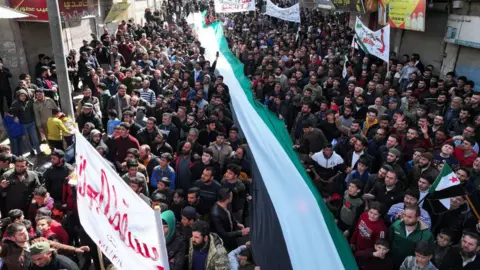
AFP
To justify its consolidation of power in Idlib and the suppression of plurality among militant groups, HTS argued that unifying under a single leadership was crucial for making progress and ultimately overthrowing the Syrian government
HTS and its civilian arm, the SG, walked a tightrope, striving to project a modern, moderate image to win over both the local population and the international community, while simultaneously maintaining their Islamist identity to satisfy hardliners within rebel-held areas and HTS’s own ranks
For instance, in December 2023, HTS and the SG faced a backlash after a “festival” held at a glossy new shopping mall was criticised by hardliners as “immoral”
And this August, a Paralympic Games-inspired ceremony drew sharp criticism from hardliners, prompting the SG to review the organisation of such events
These incidents illustrate the challenges HTS faces in reconciling the expectations of its Islamist base with the broader demands of the Syrian population, who are seeking freedom and coexistence after years of authoritarian rule under Assad
As the latest offensive unfolded, global media focused on Jolani’s jihadist past, prompting some rebel supporters to call for him to step back, viewing him as a liability
Although he previously expressed willingness to dissolve his group and step aside, his recent actions and public appearances tell a different story
HTS’s success in uniting rebels and nearly capturing the whole country in under two weeks has strengthened Jolani’s position, quieting hardline critics and accusations of opportunism
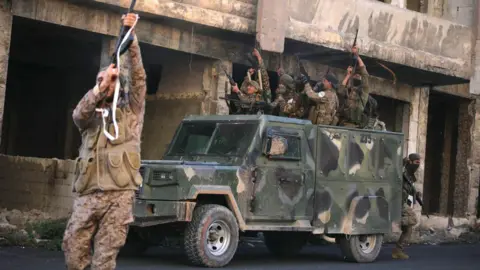
AFP
Jolani and the SG have since reassured domestic and international audiences
To Syrians, including minorities, they promised safety; to neighbours and powers like Russia, they pledged peaceful relations. Jolani even assured Russia its Syrian bases would remain unharmed if attacks ceased
This shift reflects HTS’s “moderate jihad” strategy since 2017, emphasising pragmatism over rigid ideology
Jolani’s approach could signal the decline of global jihad movements like IS and al-Qaeda, whose inflexibility is increasingly seen as ineffective and unsustainable
His trajectory might inspire other groups to adapt, marking either a new era of localised, politically flexible “jihadism” or just a temporary divergence from the traditional path in order to make political and territorial gains
Syrian civil war
Syria