
Blog
How Tapu Javeri framed an era of Pakistani fashion

Instep Today
By Shahjehan Saleem
13 September, 2026
As his archive returns to Karachi, Tapu Javeri reflects on the fashion industry he watched grow through his lens
There is something strangely permanent about a photograph in print. Long after the clothes have left the racks, the magazine has disappeared from the newsstand, the model has moved on and the building in the background has changed beyond recognition, the photograph remains. It remembers the fashion. It remembers the face. Sometimes, it remembers an entire city
Tapu Javeri understood the thrill of that permanence remarkably early
He was fifteen when one of his photographs first appeared in one of Pakistan’s most established English language newspaper. “I remember I was ecstatic. I did not really tell anybody, but when it was printed, I showed it to my mother first,” he recalls. A teacher had seen it too and praised him at school. That feeling would return with other firsts, from seeing a book printed to encountering his work on a billboard.
“There is nothing quite like seeing your work in print,” he says. “I guess only photographers who have experienced it will understand what I am saying. It is a real high that you cannot compare with anything else.”
It feels like an appropriate place to begin when looking at a career that has spent decades documenting Pakistani fashion through exactly that medium. Tapu has photographed its models and actresses, designers and runways, editorials and campaigns. His archive now stretches across generations of an industry that grew up alongside him
Yet, look through that archive long enough and another subject repeatedly enters the picture. Karachi
Tapu left Pakistan to study anthropology at Bard College and later archaeology in Greece
Photography was already part of his life, so he consciously chose to study everything around it instead
“Photography teaches you how to observe people moving around and make yourself invisible among them. You begin to study them,” he explains
“That was very similar to anthro-pology, so it became an extension of what I was already doing through photography.”
Archaeology added another layer. “Everything began to merge because, at the end of the day, all three fields study human beings from different perspectives.”
Yet, Karachi was always the desti-nation
“I always knew I would come back to Karachi. Pakistan is my home,” Tapu says. His father had another exp-ectation waiting for him: “Study whatever you want, but in the end, you have to come back and work at the shop.”
The compromise was wonderfully simple. “I would work in the business during the week and be a photo-grapher on the weekends. That is how I set up my life and how I did every-thing in those days.” One of Pakistani fashion’s most recognisable photo-graphic careers consequently began as a weekend arrangement
When Tapu returned in 1989, fashion photography largely existed within the controlled confines of studios. His generation began looking elsewhere
“When Arif Mahmood and I started photography, we did not have the equipment or lavish studios. We would take our models to locations outside studios and houses, into people’s backyards and wherever else we could shoot. It became the signature of this new generation.”
The limitation became a visual language
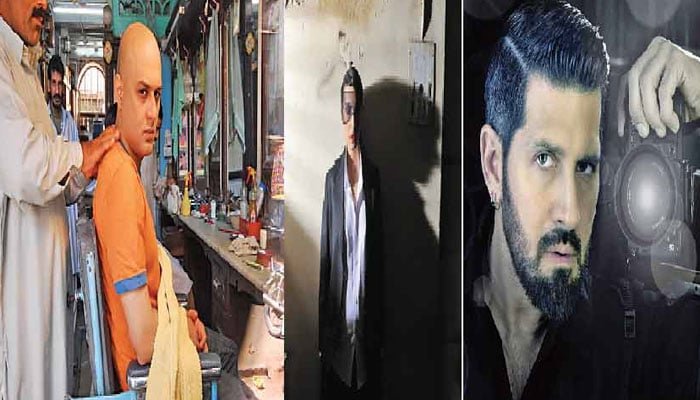
“We began looking at Karachi differently,” he says. “I remember shooting in a wide array of places, from the harbour to Makli and Chaukhandi, railway stations, old buildings and people’s homes. It became about showing Karachi in the background and placing the models in front.”
For Tapu, fashion photography and street photography consequently began sharing a frame
“Fashion became an elaborate portrait of someone on the roadside. That person happened to be a model dressed in clothes made by friends of mine because we were a very small, tight knit community of fashionistas.”
Those friends included names such as Frieha Altaf, Maheen Khan, Faiza Samee and Amir Adnan, part of a fashion community still finding its commercial shape
“When we all started, design and fashion were small, home based ventures. It was hardly an industry,” Tapu remembers. “In those days, it was a guerrilla operation, if you want to call it that. All the models were friends. All the designers were friends. Everybody was friendly with one another. There was little sense of business around it.”
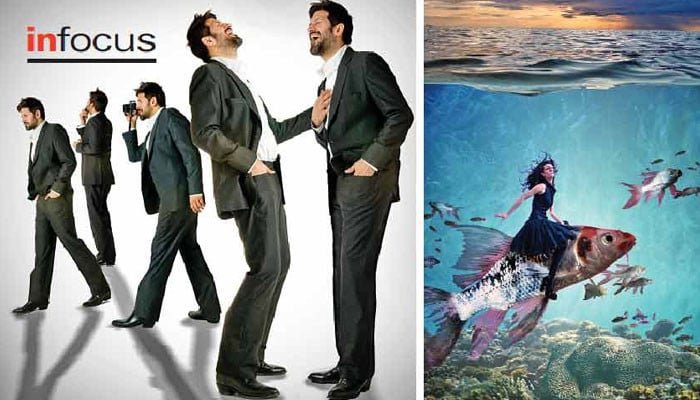
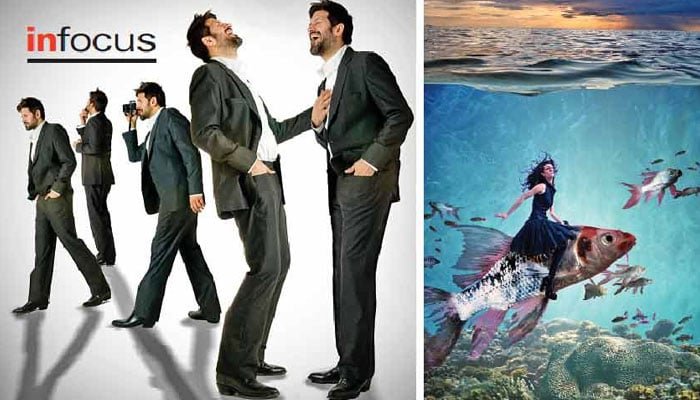
That intimacy also allowed exp-erimentation. Fashion could be dragged outside, placed underwater and subjected to whatever an image demanded. Tapu remembers photo-graphing Aaminah Haq underwater and discovering that her dress refused to cooperate. “The dress kept floating upwards, so I had to stitch lead weights into the bottom of it to keep it from rising.”
His assessment of the situation is considerably more entertaining
“Sometimes, when you take a model underwater, you have to do things that would make the designer commit suicide. It is a good thing they never found out.”
The anecdote belongs to an era when the fashion editorial carried a certain appetite for fantasy. Tapu’s celebrity portraits followed much the same instinct. With Resham, the idea was gold
“She was honestly the slimmest actress of that Lollywood era. I thought, ‘I would love to see her dipped in gold. She is so beautiful that she should become gold. She should become an Oscar.’”
Tapu painted an old bathtub at home gold and imagined filling it with gold paint before photographing Resham emerging from it. Safety concerns changed the plan, and the actress was eventually photographed in a gold lamé dress
“With every actress we photographed after that, we began with a theme and then found the actress,” he says. “The concept had to match her personality. It had to feel fun and create intrigue for someone seeing that actress or model in a new way.”
Print offered those ideas somewhere to live
When Fifi Haroon appro-ached Tapu about becoming photo editor of Xtra in 1994, he agreed with a condition: “I would have complete control over whatever I wanted to do.”
“There is so much you forget. The worst part is finding a picture and having no idea who the model was, who the makeup artist was or whose outfit they were wearing. You find older pictures that you did not consider good at the time. When you look at them again, you wonder, ‘Why did I choose that image instead of this one?’ I have around forty years of archives. There is so much work to display and share with people. Hopefully, a new generation will see it and find inspiration in it.” – Tapu Javeri
“Xtra became the ultimate portfolio for me. If I had an idea, I would go out and execute it,” he recalls. “It became the product of unbridled creativity.”
Then there was Herald. As fashion and photography exp-anded through the 1990s, so did its fashion pages
“Herald was the crème de la crème. It was where you wanted your work to be visible. Once it appeared there, people saw it and talked about it.”
And Tapu still has his own theory about what moved those copies
“The people at Herald always insisted that news sold the magazine. I can tell you that everyone I spoke to during the 1990s bought it for the fashion.”
The industry surrounding those pages has transformed enormously since. So has the technology
“When we started, you could take only twelve images. Then came rolls of thirty six. Digital photography followed,” Tapu says
With digital came Photoshop, and with Photoshop came conv-enience
“When we shot during the 1990s, if I saw a model at a party the night before a shoot, I would shout at her and say, ‘Go home and get some beauty sleep. I am not going to clean the bags under your eyes.’”
Today, he says, the response to mistakes is often: “We’ll Photoshop it.”
“That is the worst thing any photographer can say.”
He readily includes himself in the criticism. “Photography has evolved, we have become lazy and Photoshop has become something we cannot live with-out. Until models rediscover beauty sleep, I suppose it will stay that way for quite a while.”
Yet editorial photography still gives him something technology cannot automate: a reason to compete with himself
“Fashion and editorial photo-graphy remain the challenge. They are always evolving, and you constantly want to push yourself. You become your own benchmark. Your previous work becomes the standard you have to surpass.”
And across all that change, Karachi has remained remark-ably persistent
“As I have said, I have an innate love for this city. Karachi has nurtured me and created me. All my inspiration stems from this city,” Tapu says
That relationship produced projects including Kara Chakra and Kolachi Scope, while years spent as a street photographer taught him the city’s “nooks and crannies”
One encounter made him understand why documenting them mattered. At an exhibition, a visitor saw his photograph of the interior of Quaid e Azam’s Mazar and asked where it was. She had lived in Karachi her entire life and had never seen it
“That showed me how imp-ortant photography is,” he says. “It has to show people, including those living in the same city only a few miles apart, what Karachi looks like.”
And then comes perhaps the most Tapu description of his hometown imaginable
“It is a vibrant city. For a photographer who loves clutter and chaos, it is the ideal and ultimate place to be.”
At the end of September, that relationship between photogra-pher, fashion and city will once again come together thro-ugh LAAM Fashion Week’s latest event, LFW Presents: Kaleidoscopic Karachi, where a retros-pective of Tapu’s work will be presented at the iconic Indus Valley School of Art and Architecture
“I was overjoyed and thrilled,” he says of being asked to parti-cipate. “It is always a pleasure and a privilege to be acknow-ledged.”
The venue itself carries significance for him. “I never studied at IVS, but I taught there. Presenting it there brings me greater joy because I have an affinity with the institution. It is also a quintessential part of Karachi.”
Even its architecture draws him back. “The building itself lures me back again and again because it is one of Karachi’s historic buildings.” Preparing the retrospective has required Tapu to become an archaeologist of his own fashion history
“There is so much you forget,” he admits. “The worst part is finding a picture and having no idea who the model was, who the makeup artist was or whose outfit they were wearing.”
Then there are photographs that make him question his own decisions decades later
“You find older pictures that you did not consider good at the time. When you look at them again, you wonder, ‘Why did I choose that image instead of this one?’”
“I have around forty years of archives. There is so much work to display and share with people. Hopefully, a new generation will see it and find inspiration in it.”
Some faces already belong in that story
“I will definitely feature my portrait of Madam Noor Jehan,” he says. Aaminah Haq and those underwater photographs are also important to him
“I have photographed so many fabulous people who are no longer with us, and those were the people I wanted to include.”
For Tapu, this is where an archive stops being a chronology of assignments and becomes something more personal
“These are more than photo-graphs. They are memories of events that took place in my life. I am going to share those events with everyone. They simply happen to exist in the form of portraits and pictures.”
Perhaps that is also the clearest way to understand what Tapu has spent decades photo-graphing
The images record clothes, certainly. Yet collectively they also record an industry finding its confidence and a city that kept offering itself as its backdrop
Models changed. Designers grew into businesses. Magazines arrived and disappeared. Film became digital. Photoshop entered the vocabulary. Karachi remained
And there is still one portrait of the city Tapu wants to com-plete
“At this point, my passion project is a book about Karachi and its old buildings,” he says. The black and white coffee table book would bring the work of KaraChakra and KolachiScope towards its culmination
“The day I do, Inshallah, we will create an incredible book showing how wonderful this city is.”
Until then, Kaleidoscopic Karachi opens another part of the archive
After decades of photo-graphing clothes, faces and a fashion industry constantly reinventing itself, perhaps Tapu’s longest portrait has been sitting behind them all along
It looks a lot like Karachi
More From Instep Today
By Shahjehan Saleem
By Maheen Sabeeh
By Maheen Sabeeh
By Maheen Sabeeh
By Asif Khan
By Maheen Sabeeh
By Asif Khan
By Asif Khan