
Blog
The Past and Future of Giorgio Armani

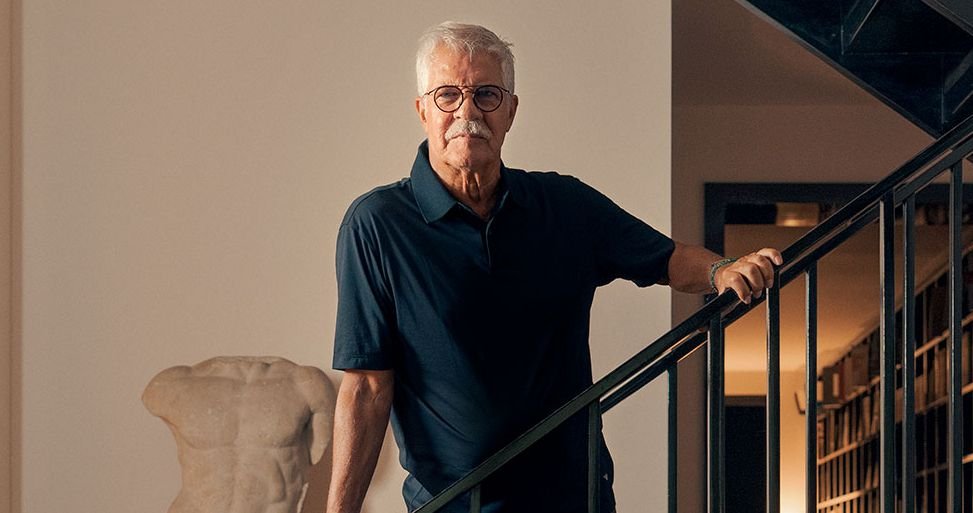
Photo: Andrea Frazzetta for New York Magazine
This article was featured in New York’s One Great Story newsletter. Sign up here
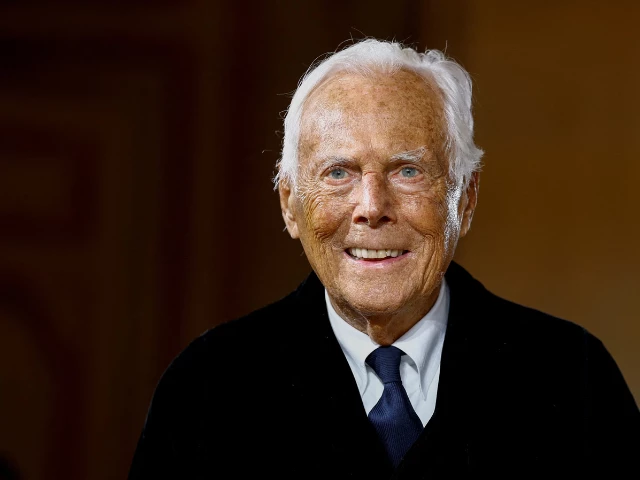
Pantaleo Dell’Orco is a shy 73-year-old with a scruffy mustache and round glasses that give him the look of a modish classics professor, one who is rarely out of black or navy clothes. In Milan, where he lives, he is known as Leo, the man who for five decades was Giorgio Armani’s shadow. The two of them shared a palazzo in the stylish Brera neighborhood and worked together at the vast fashion company Armani founded in 1975 and ruled independently as designer and chief executive until his death a year ago at the age of 91. Dell’Orco is now the creative director of menswear and the largest single shareholder in Giorgio Armani S.p.A., which is said to be worth between $6 billion and $8 billion. He is also the chairman of the board, the directors of which include Armani’s nephew Andrea Camerana and niece Silvana Armani, who is in charge of women’s ready-to-wear and haute couture.
In his will, Armani, a famously exacting boss who divvied up his fortune down to every last Andy Warhol and Man Ray, instructed his heirs to either pursue a public offering or sell the company to LVMH Moët Hennessy Louis Vuitton, EssilorLuxottica, or L’Oréal. He gave them a deadline of March 2027 to start the process by selling an initial 15 percent stake
The question of what happens next to one of fashion’s largest self-made brands has consumed an industry stuck in a multiyear sales slump and beset by change, especially in Italy, where Versace, Gucci, Valentino, and Bottega Veneta have all appointed new creative directors in the last few years with varying degrees of critical and commercial success
Dell’Orco, who has shunned the limelight for most of his life, is unbothered by the speculation about the future. He has a friendly demeanor and carries himself like someone who knows he doesn’t have to speak too loudly to be heard. In fact, he seems amused by the gossip. “It’s good for the company, the chitchat,” he tells me in August. The following month, the company made its first big move since Armani’s death, hiring Dario Vitale, a 42-year-old Neapolitan who is the most exciting new name in fashion despite having lasted only one season at Versace. He will design the diffusion line Emporio Armani, as well as accessories for the Giorgio Armani label, reporting to Silvana and Dell’Orco. The appointment positions Vitale to one day take over all of Armani and shows that Dell’Orco, like his longtime partner, makes decisions on his own terms.
Dell’Orco and I first meet in May, less than a year after a public wake drew thousands of mourners over the course of two days to Armani’s austere Tadao Ando-designed Teatro. “The whole city was there,” says Carla Sozzani, the magazine editor and founder of the influential boutique 10 Corso Como. “It’s like the king of Milano passed away. He was one of those people that you think are immortal.” Dell’Orco didn’t have much time to grieve. It was weeks away from a 50th-anniversary spectacle, and there was work to be done. “I told myself, ‘I have to be strong,’” he says.
We are at the company headquarters, a 17th-century palazzo on Via Borgonuovo not far from his own. Dell’Orco is leading a design meeting ahead of the spring 2027 collection of the flagship label, which he and Armani designed together. Now he is in charge and his nephew Gianluca Dell’Orco is his deputy. Mood boards line the wall with reference images: loose linen looks from past shoots and runway presentations, Al Pacino in a billowing khaki jacket from the mid-1990s, a sweaty Richard Gere in a nearly sheer white top. At the bottom of one board, a pinned notecard reads DANDY LATINO and LA DOLCE ELEGANZA.
The collection does not appear to stray far from the signature soft-tailored look Dell’Orco helped define, though there are subtle differences: The pants are slimmer, the jackets longer. He is not inclined to stage some kind of flashy runway stunt or drop a surprise collaboration. “Doing something just so people talk, that’s not me,” he says. “I’m not interested in being Prada.”
A refusal to bend to trends served the company’s namesake well. Armani was fully in command of his empire — three stand-alone subbrands making at least six runway collections a year; lines of accessories, beauty, fragrances, furniture; clubs, restaurants, megayachts, and even residential buildings, such as a 12-story condo in Lenox Hill — and felt little obligation to cater to commercial whims besides his own. When he decided to crash the stuffy world of French haute couture with his own version, many were skeptical, but Privé just turned 20 and is said to be one of the most successful lines within the Armani Group.
Those who know Dell’Orco well say he is as single-minded as Armani, who appreciated his candor. “Italian fashion companies are like Renaissance courts,” says one former Armani executive. “They have their prince and the courtiers. Leo would say things to Giorgio other people wouldn’t dare say.”
For many years, Stefano Pilati, who worked with Dell’Orco in the ’90s before he went on to run Yves Saint Laurent and Zegna, was rumored to be the designer to one day take over Giorgio Armani. “I found it almost offensive because it was like a way of saying to Mr. Armani, ‘You should move on,’” he tells me. “Leo is the Armani man, period. Everybody’s waiting for Armani to change somehow, but Armani has never been like this. Modernizing the brand without losing its essence requires great skill. Who else could do it? The minute it’s not Armani, it’s not Armani.”
Sozzani, who met both men in the 1970s, sees Dell’Orco as the last thread connected to the label’s origin story, someone who can’t be easily replaced. “He grew up from a child, almost, with Armani. He was born of Armani. Who else has that knowledge, that experience, that taste?” she says. “Why look for somebody else? To do what, exactly? Stay there for three seasons and then go? The accent changes, the logo changes, the packaging changes.”
An employee since long before American GigoloandMiami Vicemade Armani a global sensation, Dell’Orco has watched the brand move from upstart to powerhouse to something taken for granted by snooty magazine editors and blatantly cribbed by younger designers. He is skilled at tuning out industry talk. “Sometimes I do listen to other people’s opinions. Ninety percent of the time, I decide to do exactly what I would have done anyway,” he tells me. Plus he is not a worrier.
“I am rarely stressed,” he says. Armani himself was the opposite. To the outside world, he was the imperial control freak called “King Giorgio” by the press. But Dell’Orco remembers the private Armani who would often have nightmares before runway shows, tortured by a nagging sense he had something to prove. “He was simple, he was instinctive, he would say exactly the words you wanted to hear. He was perfect at that,” he says.
It is after 3 p.m., and we are at Dell’Orco’s home, where he now lives alone with two cats and an Indian blackbird named Merlino who chirps “buongiorno” and “Giorgio.” He receives me in an immaculate living room with slick black floors and elegant 1930s-style furniture that he is keeping just as Armani intended. Armani’s presence is everywhere. From the corner of my eye, I see his blue eyes gazing out from a Warhol portrait. “The hardest part of all was when he was holding my hand and then suddenly, I could no longer feel his touch. It was absolutely devastating,” Dell’Orco says, his voice catching. He pauses. “Sometimes I still dream about him.” In his imagination, they’re getting ready for another runway show, as they did so many times: “There are clothes everywhere.”
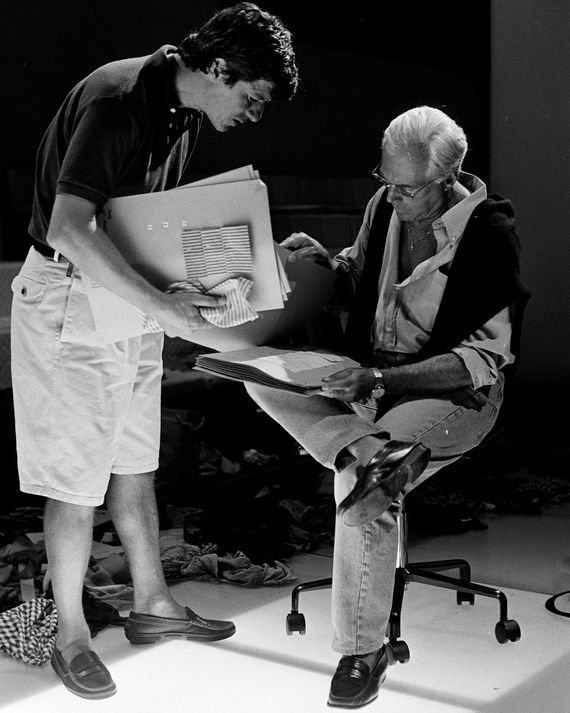
Leo Dell’Orco and Giorgio Armani before a show in 1991. Photo: Getty Images
Leo Dell’Orco and Giorgio Armani met in the summer of 1976. Dell’Orco was a tall, handsome, athletic 23-year-old hanging with two friends at a dog park off Via Gerolamo Tiraboschi. The group was debating whether to see a movie or hit a nightclub when a friendly dog, a boxer named Jago, wandered over. He belonged to a 41-year-old man with an intense stare and graying hair. “It was fate,” Armani wrote years later. “It was a particular meeting that could only have happened in that moment,” Dell’Orco says.
Dell’Orco had never heard of the designer, who had founded his business a year earlier with money from the sale of his Volkswagen Beetle. Dell’Orco was a technical draftsman from Puglia working at a large gas company, and soccer was his only interest outside the office
Armani, meanwhile, had been a stilista since the 1960s, working for Nino Cerruti and designing lines for manufacturers such as Ungaro and Zegna. He ran his burgeoning namesake label with his partner, Sergio Galeotti, who focused on the business side of the operation and had encouraged Armani to strike out on his own shortly after they met at the beachside nightclub Capannina di Franceschi in Forte dei Marmi in the summer of 1966. The relationship was romantic for a time, but as Armani once put it, “the term love is too narrow. We were allies in the face of life and the rest of the world.”
At the dog park, Dell’Orco’s friend struck up a conversation with the designer, who invited them over to his house for an aperitivo. There, he asked if they might be interested in modeling in his upcoming runway show. “I said, ‘Hmmm, why not?’” Dell’Orco says. A few days later, he and a couple of friends showed up at a small studio on Corso Venezia, where a secretary handed them some clothes to try on. One friend was declared too short. Dell’Orco made the cut.
“The whole atmosphere of doing a runway show, the rehearsal, it was all very exciting,” he says. In a photograph in the trade newspaper Footwear Newsthe following spring, Dell’Orco saunters down a runway with a jacket thrown over his broad shoulders, one hand in his pocket. He became a part-time fixture at Armani’s studio, doing odd jobs and helping to develop fabrics
At the time, French fashion was more popular and prestigious than Italian labels. When Miuccia Prada handed out leaflets for the Italian Communist Party as a college student, she wore Yves Saint Laurent and Courrèges; the business her grandfather started in 1913 made only leather goods then. Armani was part of a competitive cohort of Italian designers, including Gianni Versace and Walter Albini, who challenged French superiority with wearable clothes for Italian yuppies, the paninari. “Milano became the capital of fashion in quite a short time,” says Sozzani, who until the late 1970s was almost always wearing Saint Laurent. “There was this square in Milan, Piazza San Babila, where everyone wore a down jacket, Armani jeans, Timberlands, and an El Charro belt,” Dell’Orco says. “It was a democratic fashion. That is to say, if you were good-looking, it showed.”
From his first collection, Armani’s sales pitch for men was a relaxed, unpretentious style, one he would obsessively refine again and again: unstructured suits made from soft, sensual fabrics such as silky gabardines traditionally used for women. “He invented the sexy suit,” says Gene Pressman, the former co-CEO of Barneys, which introduced the brand to the U.S. “Before that, men didn’t wear greens and browns. They were strictly navy and gray. Armani introduced a whole palette. He used all the wonderful colors of Tuscany. It was very revolutionary.”
At first, Armani’s suits were too avant-garde for most Americans looking for standard-issue office suits. Then, in February 1980, American Gigolo premiered, and Richard Gere turned Armani’s soft jackets and front-pleat trousers into the most seductive thing a successful man could wear. “Wall Street went nuts, and all of a sudden, these young kids were buying ten suits at a time,” says Pressman. “They’d lay out like 30 shirts, 20 ties, all kinds of accessories, and we couldn’t get them on the racks fast enough to go over to the alterations department.”
Months later, Armani staged an elaborate runway show underneath the Prometheus statue outside Rockefeller Center for 1,000 people, including Carrie Fisher and Lauren Hutton. Dell’Orco, on his first visit to Manhattan, modeled. “It was the most over-the-top place, a surreal place. You didn’t understand where you were,” he recalls. “It was exciting, doing the runway show next to Iman.” Emporio Armani launched in 1981, followed by jeans, fragrances, and a children’s line. Revenue tripled to 26 billion lire, the equivalent of $63 million today. “Armani, at that time, was really a god in Milan,” says Pilati. The next year, “Giorgio’s Gorgeous Style” landed on the cover of Time.
Around then, Armani and Galeotti hired some relatives to join a team that had grown to about 100 employees: Silvana, the daughter of Armani’s older brother, Sergio, and two of Galeotti’s nieces. “That marked the turning point. From that moment on, the company became more of a family affair,” says Dell’Orco, who had joined the men’s-design team full time. His relationship with Armani had also evolved. “There are some things that are hard to explain. It happened naturally,” he says. “A 20-year age difference was a lot, but I must be sincere: It’s something that came on its own.” Though it was not publicly discussed, everybody understood Dell’Orco to be especially close to the boss. “Leo was a humble assistant in a superior position because there was a relationship,” says another colleague from the early years of the business. “He learned everything from Armani. He was next to him all the time.”
In 1984, as sales soared, Galeotti was diagnosed with AIDS and sought treatment in New York. Armani visited every month. “A couple of times, I went along as well, and those were not easy visits,” says Dell’Orco. The disease was ravaging the fashion industry, and everyone knew someone affected. The designers Chester Weinberg, Willi Smith, and Roy Halston Frowick would die from AIDS-related illnesses by the end of the decade. Armani threw himself into the business. “During that dreadful year, I lived as if I was holding my breath, without thinking about the inevitable, working day in and day out,” he wrote in his memoir.
Galeotti died in August 1985 at his home outside Paris with members of his family by his side as well as Armani and Dell’Orco. He was 40. The New York Times attributed the cause to a heart attack brought on by leukemia. Armani was bereft. He described Dell’Orco as a great source of comfort: “I will never forget how much he helped me through the sad events surrounding Sergio’s illness, in that undisturbed countryside not far from Paris.”
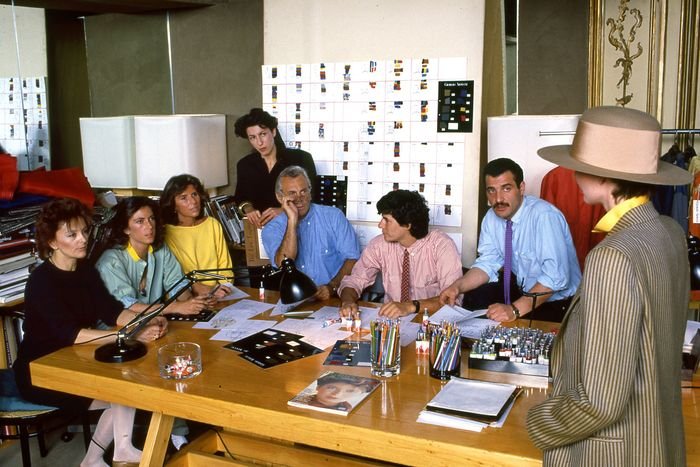
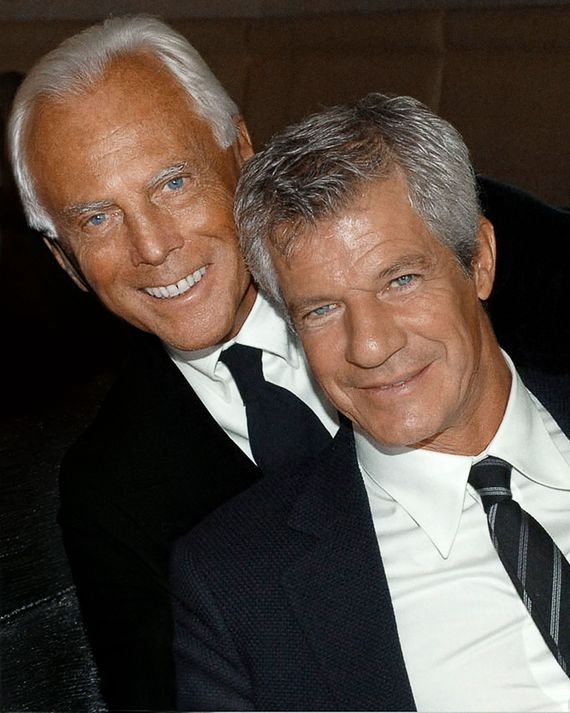
From left:In 2000. Photo: Getty ImagesWith the design team in 1982. Photo: Courtesy of Giorgio Armani
From top:In 2000. Photo: Getty ImagesWith the design team in 1982. Photo: Courtesy of Giorgio Armani
Resilience was written into the Armani story from the beginning. In his memoir, he described growing up under Mussolini in Piacenza, which was a frequent target of Allied bombing during World War II. The oft-repeated story goes that he was 10, playing with friends on the street, when someone stepped on an undetonated packet of gunpowder, killing one boy and landing Armani in the hospital with severe burns. He never tired of telling people that doctors were convinced he wouldn’t see again. After Galeotti’s death, he felt underestimated once more. He was now the sole owner of a complex and growing company, and he didn’t have a partner to handle business affairs while he designed. A string of key deputies left, and the business seemed troubled. “Many believed I would collapse psychologically,” he wrote.
Instead, Armani took on Galeotti’s job as the head of the finances, assuming a dual business and creative role that he would hold for the rest of his life. The label flourished. “Giorgio never listened to anybody. He knew exactly what he wanted,” says Sozzani. “Until the end of the ’80s, early ’90s, there were five big players in Italy: Valentino, who was in Rome, and in Milano there was Gianfranco Ferré, Krizia, Versace, and Armani.” Today, none except Armani is independent — Versace, a once-formidable competitor, is owned by Prada, and a Qatari investment fund controls 70 percent of Valentino, the famous founder of which died earlier this year; Krizia and Ferré are glorified licenses owned by foreigners. Armani had the foresight to set up highly profitable licensing agreements for makeup and fragrances with L’Oréal and for sunglasses with the eyewear giant Luxottica. Throughout the 1990s, sales grew by double digits every year. And later, he brought manufacturing in-house so as to control a larger share of the profits. Through it all, Dell’Orco was by his side.
“The sense of calm I projected was something he appreciated,” Dell’Orco says. “I was happy there, and the years passed without me realizing it.” He doesn’t even remember when exactly he moved into the palazzo on
Though they had been together for decades, Dell’Orco remained in the margins of Armani’s public life. He was sometimes mentioned as a close friend in articles, but the news media, especially in Italy, afforded King Giorgio an unusual degree of privacy. Discretion suited Dell’Orco, too. Gay marriage isn’t legal in Italy, but when I ask if he and Armani ever talked about getting married, he shakes his head, as if I were breaking some unspoken rule. Did he feel married? “It is something I never thought, never said.” They were known to bicker over decisions small — hats in a collection, which Armani loved and Dell’Orco less so, or heels, which Dell’Orco preferred over Armani’s usual choice of flats — and big, like the 2004 launch of the activewear line EA7, which Armani initially fought but Dell’Orco knew would sell well.
“Leo is from another generation, so obviously he pushed for younger trends,” says Pilati. “Mr. Armani either took his ideas or said ‘Leo, piss off.’ But even if they were fighting, Leo never bitched about Mr. Armani. That was one of his best qualities. I’ve never seen someone so serene.” Federico Marchetti, the founder of the e-commerce giant Yoox, joined Armani’s board in 2020 and observed their dynamic. “Leo was the person Mr. Armani listened to the most,” he says. “In the middle of all these people saying ‘yes, yes, yes,’ he is someone who sometimes said ‘no.’ He’s that kind of a partner.”
Dell’Orco laughs when I ask about the quarrels with Armani. It took years for him to feel comfortable speaking his mind in the atelier. “Giorgio was, let’s say, more conservative. I wanted to inject a bit of youthfulness into things. Little by little, he came to trust me,” he says. “If we fought at 1 p.m., we would go have lunch after, and for me it had already passed. That’s the thing that made it work. If not, it would have been a whole drama.”
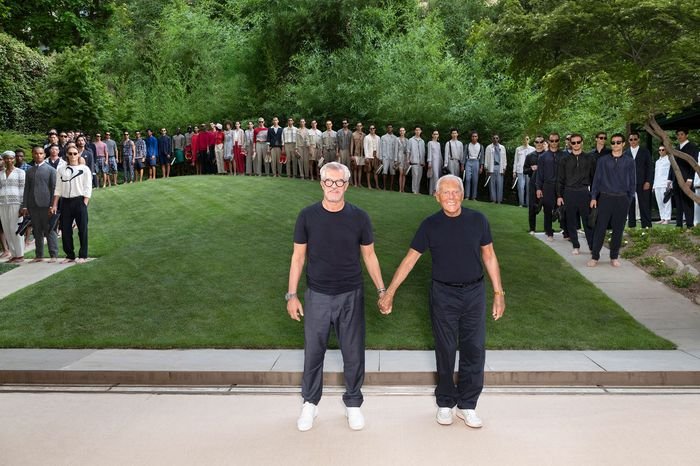
Taking a bow in 2021.
Photo: Stefano Guindani
The duo finally took a bow together at the end of a men’s-fashion show in 2021. In matching navy T-shirts, slacks, and white sneakers, they raised clasped hands to a standing ovation from the crowd. Quietly, Armani, long resistant to public discussions about retirement or succession, had made moves to set up the company for the future. In the early aughts, when the luxury industry began to rapidly consolidate, he shared a much-scrutinized cup of tea with Bernard Arnault, the chairman of LVMH, and he came close to selling to what was then known as the Gucci Group, a precursor to Kering, before pulling out at the last minute. “He was very concerned about keeping absolute control over the company, which I respected,” says Domenico De Sole, who was CEO of the Gucci Group at the time.
The fear of losing control never left Armani, and in 2016, he created a foundation to oversee the management of the company, led only by himself, his financial adviser, and Dell’Orco. His will stipulated that the foundation would always retain at least a 30 percent stake in the company to ensure it is run with a series of founding principles, including a creative mandate to maintain “an essential, modern, elegant, and unostentatious style with attention to detail and wearability.” Dell’Orco, who now chairs the foundation, supported the approach, which would guarantee a continuation of what they had built: “He’d say things like, ‘Let’s sell everything!’ and I’d reply, ‘Sell it to whom?’ He never actually meant it.”
The two sometimes fantasized about retirement, but the idea was just as quickly shrugged off. “As long as he was working, he felt good,” Dell’Orco says. “Work was his life. He had no hobbies.” Once, a couple of years ago, Armani asked how much longer he intended to keep going. A decade, Dell’Orco told him. “Look, it’s tough,” Armani warned him. “You worked until you were 90. Why can’t I?” Dell’Orco responded.
Still, they never explicitly discussed Dell’Orco one day becoming chairman of the board and having voting power in the company’s most important decisions. “In a way, deep down, I understood that eventually I would be the one,” he says. “But it’s something I never voiced aloud, nor did I ever put myself forward for it. He figured it out on his own.”
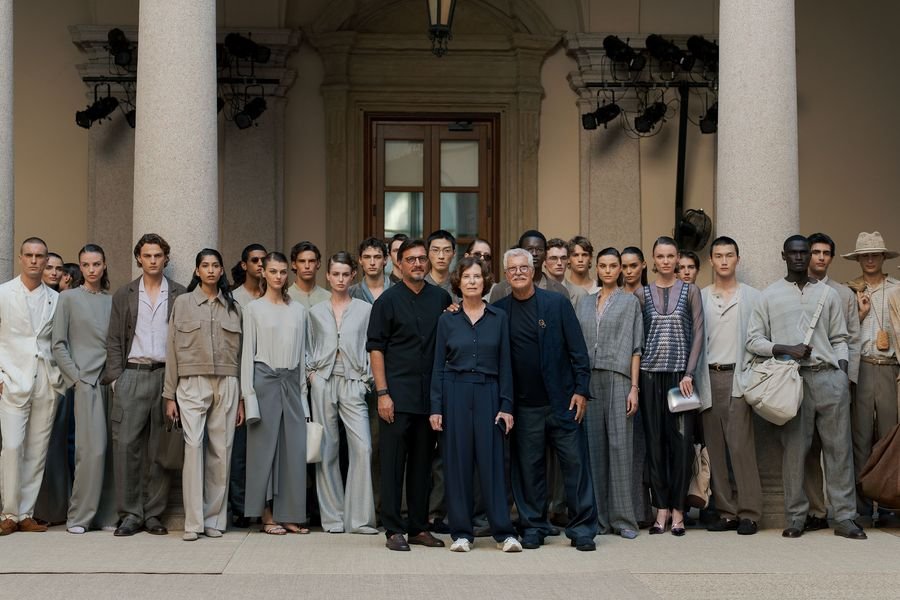
Gianluca Dell’Orco, Silvana Armani, and Leo after the Giorgio Armani spring 2027 men’s show.
Photo: Andrea Frazzetta for New York Magazine
At the end of the summer, Dell’Orco WhatsApps me while on vacation near Mykonos from the family’s 65-meter superyacht Maìn(the nickname of Armani’s mother). Armani preferred Pantelleria: He found Greece too windy, but Dell’Orco appreciates the water here, the local taverns. For once, he is out of his dark uniform, wearing a white T-shirt that highlights his gray hair. Armani would sometimes scold him for wearing other designers, but lately Dell’Orco has been adding to the mix — Rick Owens, Sacai, Comme des Garçons. By his sunburned face, I can tell he has been enjoying his time off. He even went out in Ibiza, though he was taken aback by the looks he saw. “Men are more dressed, and women are much less dressed,” he says. “I want a woman who’s more chic.”
The collection he had first shown me in May was well received during Milan Men’s Fashion Week, where it was presented alongside Silvana’s cruise lineup. Gone were the hats that were the subject of so many arguments with Armani. Shirts and pants looked lived-in, the bags almost beaten up. Fabrics leaned heavily on linen, washed silk, and ultrasoft denim. The styling was more casual, and the models seemed at ease, not like the stiff Italian Ken dolls of the past. It was the most relaxed Armani has looked in years, and still some critics complained that it lacked the cool of labels such as Prada, where punk skinny jeans and leather jackets portended a change in men’s silhouette, or Ralph Lauren’s surprisingly trendy prep maximalism.
From his floating mansion in the Aegean, Dell’Orco isn’t too broken up by the critics, nor is he overly impressed with the season. “I saw that quite a few designers tried to do things that were a bit out there,” he says diplomatically. “I like to stay the course. I don’t push just to push.” For now, that means embracing what the brand does best, like tailoring and suiting, a sound strategy given how popular vintage Armani is on the resale market. Last year, to capitalize on the hype, the label reissued several classic Armani styles, such as single-pleat trousers from 1990 and a double-breasted leather jacket from 1979, for a capsule collection called Archivio. “Giorgio always wanted to create something new so that people talked about him more,” Dell’Orco says. “For him, the suit was too banal. At this moment, I feel we need to get back to it.”
Perhaps more urgent than whether the pants are skinny enough is the looming question of Armani’s ownership. Since we last spoke, a report in La Repubblicasuggests the initial 15 percent stake sale could be split among the three preferred suitors, a move that is widely seen as a way to leave open the possibility for a potential majority sale later on. The stake sale might also be delayed beyond Armani’s self-imposed 2027 deadline, sources told the newspaper, because of headwinds in the luxury market. Like many of its competitors, Armani is experiencing a dip — revenue, not counting licensing royalties, declined 5 percent in 2024, to $2.7 billion, and 2.8 percent in 2025, to $2.6 billion. It’s not a crisis, not yet, but it’s far from an ideal track record for going public or selling at a high valuation. A listing comes with its own complications, too. For one, the company has to demonstrate it can grow profitably at a vigorous pace and keep up quarter after quarter. “People are not buying the past in the stock market. They want to buy the future,” De Sole says.
Armani, though, is a unique asset: It is globally recognized and has substantial cash reserves and no debt. Its licensed lines with L’Oreal and EssilorLuxottica generated an estimated $2.3 billion in 2025. The brand is diversified while avoiding the kind of overexpansion that can turn blue-chip labels into discount slop. “The foundations are beyond rock-solid,” says Graziano de Boni, a former CEO of Armani’s North American subsidiary. “It is the only fashion brand that goes from fast fashion to couture and nobody complains.” The stability of the business, and its snoozy reputation, may actually work in its favor. “They didn’t have all these swings that many other fashion houses had in the past,” says Marchetti, who navigated the Yoox IPO almost 20 years ago. “That’s what the family and the board are trying to continue.”
Dell’Orco cannot make any major decisions about an outright sale or a public offering without the support of either Silvana Armani or Andrea Camerana. The family has so far avoided painful disagreements, the kind of succession drama that plunged Luxottica into a messy squabble after the founder, Leonardo Del Vecchio, who died in 2022, left the $46 billion fortune in the hands of eight heirs from three different marriages. That is not the Armani way. When Dell’Orco and Silvana meet with employees to discuss pending items, or sospesi, they still leave the head of the table, Armani’s seat, empty. “Managing to keep everyone together — the whole group — is the most important thing Giorgio did,” Dell’Orco says. “Before long, we’ll be bringing in some partners.”
Although he anticipates the initial stake sale will go forward as planned by next spring, Dell’Orco does not seem to feel much urgency. “We cannot simply remain as we are,” he says. “I want to grow gradually, to reach a revenue level that is a bit higher — let’s say $4 million or $5 million — compared with where we stand right now.” Instead of selling a majority stake, Dell’Orco tells me he hopes Armani will go public at some point: “Because I would feel more free.”
The first time we speak, his own future does not seem in doubt. Like Armani, he loves the work. Still, he allows that change is inevitable. “But change to what extent?” A month before Vitale is formally hired, he seems closer to answering his own question. An outsider, someone who is not beholden to the past, is good for the company, he says. “They need to be someone who has a clear vision. They need to be able to see things for themselves, to make a judgment and then step in.”
The Past and Future of Giorgio Armani