
Blog
Impact investors confront fashion’s ‘volume paradox’ | Impact Investor

Source: Impact Investor, 4 August 2026
Impact investors confront fashion’s ‘volume paradox’
Posted in category:
Written by:
- Karolina Adamkiewicz
Published: 4 August 2026
As fast fashion and its societal and environmental impacts continue to gather pace, Impact Investor investigates the challenges of the sector and the opportunities available to investors to drive lasting change
From the overconsumption of natural re human rights abuses linked to a business model largely reliant on cheap ‘sweatshop’ labour, the human and environmental toll of fast fashion has been widely documented
In April, Ponda, a biomaterials company which has developed BioPuff, a plant-based insulative material made from wetland-grown bulrushes, launched a crowdfunding campaign to scale its technology, adding to a long list of impact startups working to disrupt the fast fashion value chain with more regenerative and sustainable technology and business models
The impact potential of Ponda’s technology and other technological solutions like it are often presented as vast. Ponda, for example, says that the drained wetlands it is trying to restore through paludiculture (the cultivation of crops on rewetted peatlands and other wet landscapes) release 1.9 gigatonnes of CO2 a year, around twice fashion’s total annual emissions
But how impactful have these solutions been in turning the tide of fast fashion and where should impact investors be channelling their attention?
The impact of these technologies is likely to be limited without addressing the overproduction and ever shorter lifecycle of fashion. According to Fashion for Good, a collaborative innovation platform working to transform the fashion industry, global textile production and consumption have doubled over the past 15 years, while the number of times a garment is worn has dropped by 40%, averaging only seven uses before it is thrown away.
María Samoilova head of IB Deuda Impacto España, a Spanish social impact debt fund, which has several holdings focused on sustainable fashion, calls this the “volume paradox”
“This decoupling of production from utility creates a crisis of waste,” she says

This is backed by research. In the EU alone, the amount of used textiles tripled between 2000 and 2019 from slightly over 550,000 tonnes to almost 1.7 million tonnes. A recent report published by Fashion for Good and global impact organisation Circle Economy, based on a year-long investigation into the global secondhand clothing system, found that most of these clothes are wearable
“Ultra-fast fashion has successfully democratised trends by lowering prices, but this relies on a model of psychological obsolescence,” says Samoilova, explaining that the challenge for impact-driven brands like Ecoalf, a holding in IB Deuda Impacto España focused on advancing responsible textile innovation and circular design, is to prove that a business can thrive by encouraging consumers to buy less, but better.
Beyond reducing production and consumption, Bernadette Blom, founding partner of Dutch impact investment firm FOUNT, which manages the Good Fashion Fund (GFF) and is raising capital for GFF 2, a fund focused on apparel manufacturers in Bangladesh, India and Vietnam, says the biggest sustainability challenges and opportunities in fashion remain upstream in the supply chain. This is about targeting SME-sized apparel manufacturers where most of the sector’s energy use, water consumption and chemical processing occur.
“Dyeing and finishing processes are especially reoducing countries,” says Blom

Samoilova also raises the issue of the ‘fossil-fashion technical lock-in’, with 60% of global textiles derived from fossil fuels, primarily polyester
“The industry is currently ‘locked in’ because synthetic fibres offer a combination of price, durability, and performance that is difficult for natural or bio-based alternatives to match at scale,” she says, adding that her fund addresses this not by avoiding synthetics entirely but by championing radical innovation
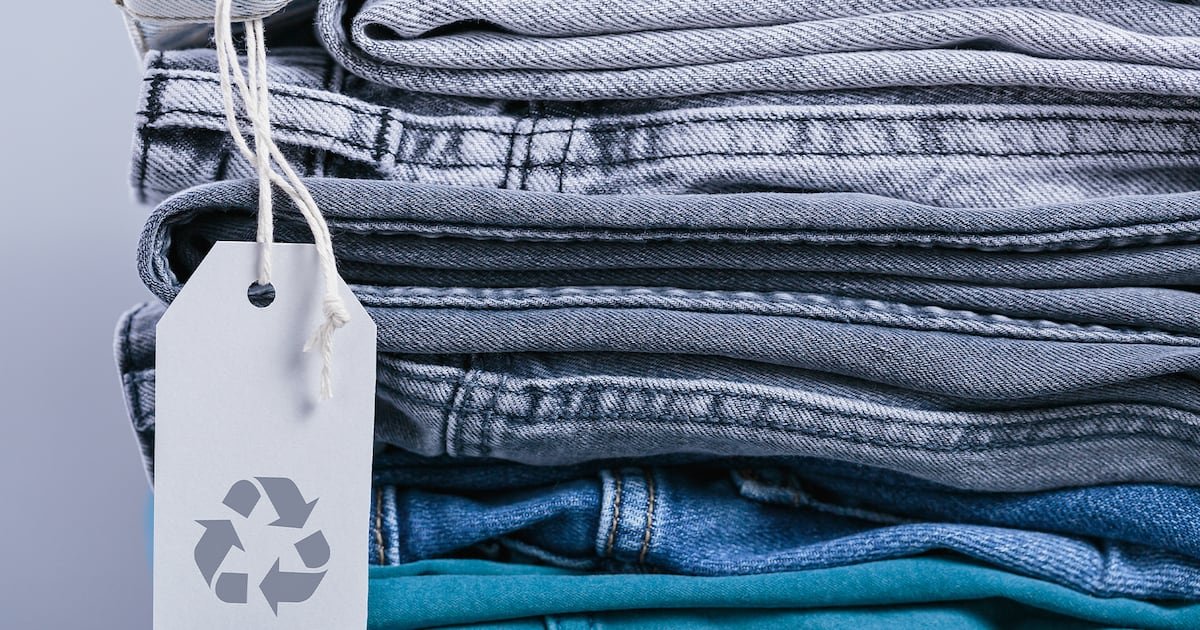
An often-pedalled solution to clothing waste is recycling but today, less than 1% of material from old clothing is used to make new clothing. Part of the problem is the lack of technological infrastructure
“While many brands market ‘recyclable’ collections, the reality is that less than 1% of clothing is effectively recycled back into new garments,” says Samoilova explaining that the industry’s reliance on blended fibres, like the common cotton-polyester mix, creates a technical ‘dead end’ for recycling
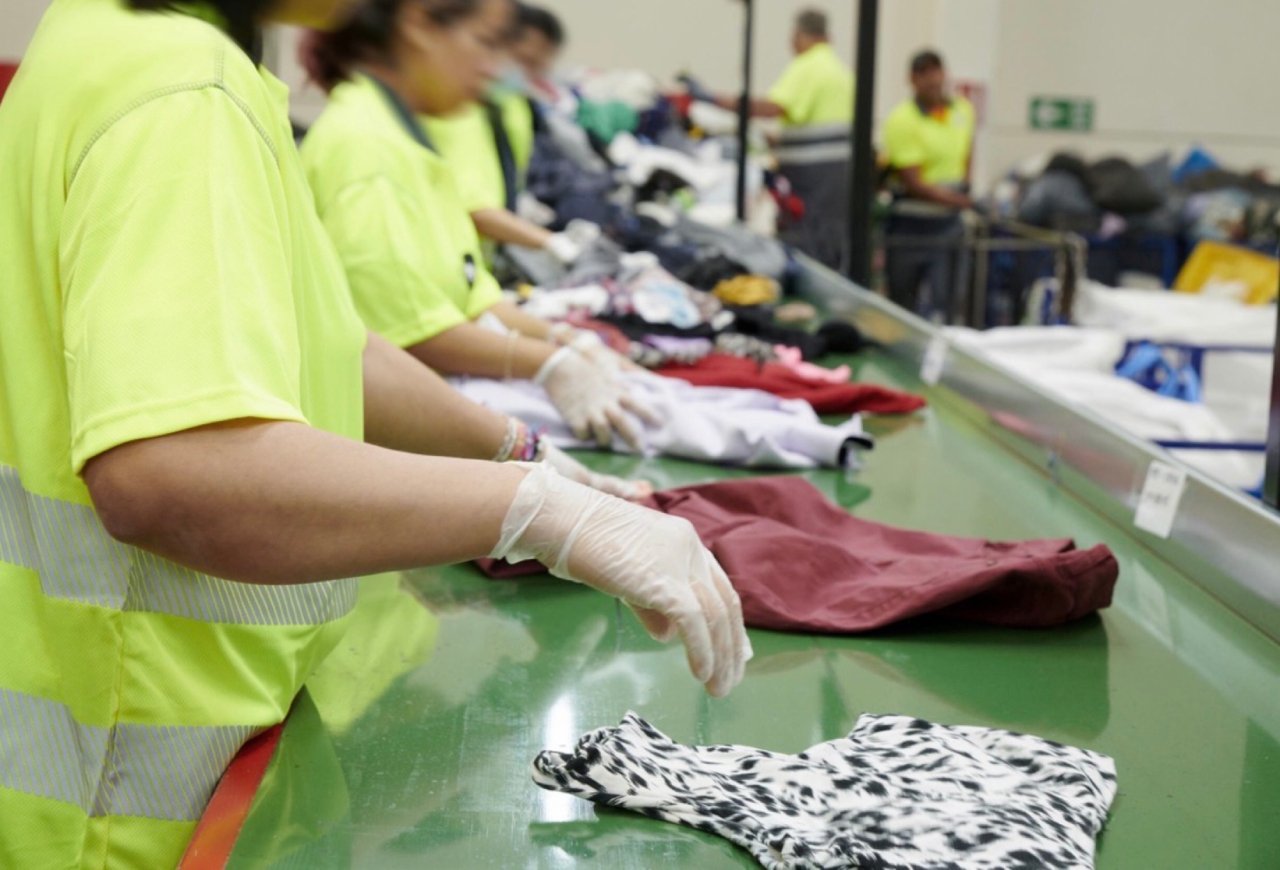
“True circularity requires two things the industry currently lacks, eco-design and industrial infrastructure. This is where our investment in Moda re- is critical,” she says, referring to the social initiative promoted by Cáritas, which employs more than 800 socially marginalised people, including prisoners who qualify for day release and work at the company’s recycling plant in Barcelona, to manage the collection, reuse, and recycling of garments in Spain.
But even the Fashion for Good and Circular Economy research, which looks at opportunities to scale the second-hand clothing market, including through the sorting of rewearable textiles using AI technology to improve garment recovery for resale, acknowledges that without a reduction in production, circular strategies risk functioning as a parallel market rather than a systemic solution
The social dimension is also critical. Incidents such as the Rana Plaza disaster in Bangladesh, which claimed the lives of 1134 garment workers, are only the tip of the iceberg in an industry plagued by poor working conditions and low wages driven by demand to keep costs down. Gender equality is also an issue
“Sustainability challenges are also social,” says Blom, explaining that a large share of the millions of workers employed in the apparel sector are women
“While the industry provides employment opportunities for women, challenges remain around fair wages, safe working conditions and gender equality in career advancement,”’ she adds
Samoilova says her fund’s investment into Moda re- is also “transforming waste into a tool for social insertion” and showed “that the solution to fashion’s waste problem can also be an engine for decent work and social dignity.”
Despite the multiple challenges, Blom says the sector has made progress in recent years with many brands setting climate targets and increasing their focus on supply chain transparency and decarbonisation. However, a significant gap between commitments and implementation still remains, and many SME apparel manufacturers continue to have difficulty in gaining access to traditional financing to transition their business models, she says.
“Local banks tend to view sustainability upgrades as risky or non-core investments, while institutional investors typically focus on the larger manufacturers,” she explains, adding that this leaves a financing gap for businesses that want to invest in decarbonisation and presents a significant opportunity for impact investors
“We do see a big opportunity for decarbonisation of the textile supply chain by financing solar rooftops plus other renewable energy mechanisms reducing emissions and costs and at the same time improving worker wellbeing and gender equity. GFF 2.0 focuses specifically on this segment,” she says
Blom also highlights the importance of working hand-in-hand with brands from the outset
“Brands can help unlock investments by providing subsidies, purchasing Distributed Renewable Energy Certificates generated by supplier solar installations, or offering other forms of financial support. Aligning incentives between brands, manufacturers and investors is key to scaling these solutions,” she adds
Looking ahead, Samoilova says the future of fashion investment isn’t in selling more items but in managing the lifecycle of those items
“That is why we expect a massive surge in infrastructure investment. Spain, for instance, only collects 12% of its textile waste today. To meet EU targets, we need a radical scale-up of processing facilities. Investments in these facilities, like Moda re-‘s plant in Sabadell, become more necessary every day,” she says
Regarding retailers, Samoilova says the winners will be the brands that can successfully decouple business growth from re
“We look for industry contrarians like Ecoalf that explicitly distance themselves from aggressive consumption events like Black Friday. We agree with them that in a world of finite retimelessness and durability over seasonal trends,” she adds
Share on social media