
Blog
Is Fashion’s Content Model Still Fit for Purpose?

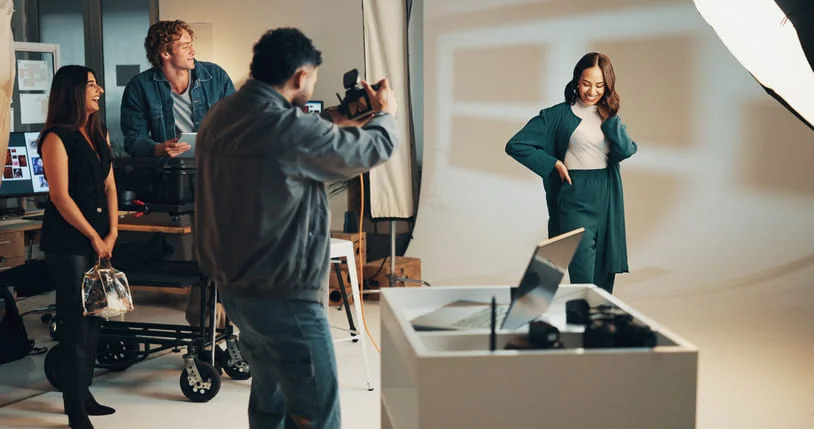
Everyone is asking whether AI will replace creative teams, but shouldn’t we be asking what creative teams should actually be spending their time on? The brands seeing the greatest value from AI are those redesigning the way creative work gets done
Five years from now, fashion brands could be creating more content in a year than they have produced in their entire history. But most creative teams aren’t built to operate at that scale. And few are asking what that means for how creative work gets done
When online luxury retailer Ssense recently laid off members of its photography, retouching, and hair-and-makeup teams, citing advances in AI-generated imagery, the reaction was predictable. Once again, the discussion became another debate about whether AI is replacing creatives – which is only part of the story
The real issue is that brands like Ssense are being asked to create exponentially more. A campaign that once required a handful of hero images now needs thousands of assets across markets, formats, languages and channels. In that context, reducing production teams while content demand continues to grow only looks contradictory if we assume the volume of creative work is staying the same. It isn’t.
No creative team was ever staffed to hand-produce content at this scale
For many retailers, the challenge is no longer how to produce hundreds of thousands of images a year, but how to produce millions. Seen in that context, the Ssense layoffs look less like an isolated workforce story and more like a business adapting to a production model that is changing fundamentally. AI is becoming the only realistic way to meet that level of demand without expanding production teams at the same pace.
I’ve watched this from both sides. About eight years ago, I started working closely with creative teams to understand why producing more representative imagery always seemed to hit the same wall – the math simply didn’t add up. Every request for more body types, more skin tones, more sizes and more localised content meant more photoshoots, more models, more studios and more operational complexity. The most-photographed size was usually the retailer’s best-selling size, with no real way of knowing how many customers simply couldn’t picture themselves wearing the product. That was the moment I realized fashion didn’t have a creativity problem, but a production problem.
Fashion never had a creativity problem
A campaign that once needed a small set of hero images now demands thousands of assets, across websites, apps, marketplaces, social platforms, email, retail displays, languages, body types, and markets. Most analysis of AI in fashion still assumes its job is to replace the assets teams already make, image for image, more cheaply, whereas brands are asking how to make millions that were never economically possible before. ASOS is a clear example. Earlier this year, the retailer partnered with an AI platform to upskill more than a hundred designers, moving them from hand-drawn sketches to AI-assisted photorealistic renders and rapid colorway exploration
Not every creative task Is creative
Fashion has a habit of talking about creative work as if it’s all the same thing. It isn’t. Coming up with the original idea, defining the visual language of a campaign or deciding how a brand should look are fundamentally different from producing hundreds of variations of that same work across markets, channels and formats. The industry blurs that distinction surprisingly often, despite priding itself on taste and creative judgement.
Scaling a campaign, localising assets or producing endless image variations is essential work, but it is also repetitive by nature. Repeating the same process a thousand times doesn’t become more valuable simply because a person carried it out manually. The value lies in the original creative decision; once that decision has been made, AI is increasingly capable of executing it consistently and at scale. A company reducing its photography or retouching capacity is making a statement about how repetitive production work gets done, not about whether creativity itself still matters.
Human judgment becomes more Valuable, not less
The assumption that AI removes people from the process is wrong, and it’s wrong even in the deployments that actually work. Technology generates options, but it doesn’t decide whether an image reflects a brand’s identity, whether a campaign feels emotionally right or whether a shopper trusts a visualization of a product they’ve never touched. Those are human decisions, and the more content AI produces, the more those decisions matter, not less. Weak judgment on ten images is survivable. Weak judgment on ten million is systemic. At that scale, creative judgment becomes part of the production system itself.
Gucci’s campaign ahead of Milan Fashion Week in February 2026 demonstrates how easily the conversation around AI can become a conversation about brand identity. Although the imagery was explicitly labelled as AI-generated, much of the reaction focused on whether it still reflected what people expected Gucci to be. Somewhere between image generation and publication, no one is looking at if this still feels like Gucci.
As production volumes increase, review becomes just as important as generation. Every image still needs someone to decide whether it belongs to the brand. That’s how retailers can scale to tens or hundreds of thousands of SKUs without betting their brand on an unsupervised model. Without accountability, scale can become a liability
AI is infrastructure, not software
Software helps people do existing work faster. Infrastructure changes what an organisation is capable of doing, and I think AI is rapidly moving into that second category, even if much of the industry still treats it as just another creative tool. Once that happens, the conversation shifts from “Should we adopt AI?” to “How should our organisation change now that this capability exists?” ASOS upskilling more than a hundred designers only makes sense if you’re asking the second question. Nobody invests in transforming the way creative teams work around a technology they’re still treating as an experiment.
For decades, fashion companies have created new imagery every time a campaign, market or customer changed. Increasingly, they’ll create a high-quality digital representation of a product that can be adapted across different channels, audiences and commercial contexts without starting the production process from scratch each time. Instead of photographing every possible variation, creative teams will define the standards, quality and visual identity that every future variation needs to reflect. That changes the role of the studio, but it also changes the role of the people working within it. The competitive advantage will no longer come from producing more images than everyone else but from building production systems capable of delivering the same creative vision consistently, regardless of how many versions a retailer needs to produce.
What fashion leaders should know
What enterprise fashion needs to think about now is less about which AI tool to buy and more about how organisations evolve once content is no longer constrained by traditional production. That doesn’t necessarily mean smaller teams, but it does mean different ones. Creative teams are becoming more and more important for making decisions that technology cannot, like defining quality, safeguarding brand identity, and using the judgement that keeps every output recognisable, as AI takes over more of the repetitive tasks involved in creating, modifying, and scaling content. As the Ssense example demonstrated, this may appear to be a headcount story from the outside, but what is actually being redistributed is an organization’s most valuable resource in the form of the time and attention of those who understand what the brand should represent.
The organisations that benefit most from AI won’t be the ones generating the greatest volume of content. They’ll be the ones that redesign themselves for a world in which producing that content is no longer the constraint, freeing creative talent to focus on the work that gives a brand its distinctive voice in the first place
Go to top